



By Mike Mackey, Field CTO, Mobolutions | Former SAP Principal Solution Advisor
Setting the Scene
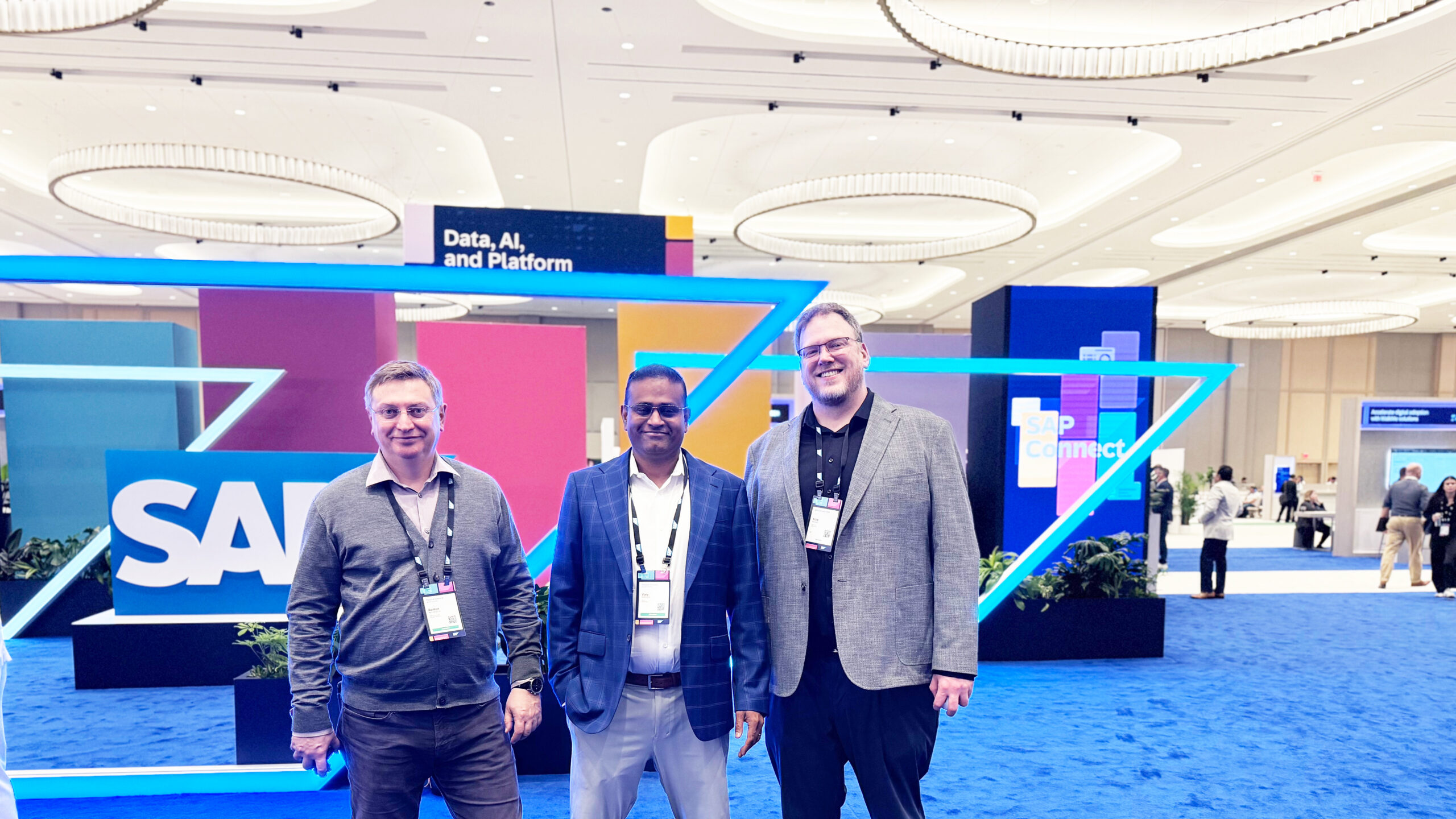
In October, I stood on two very different stages: under the Las Vegas lights at SAP Connect 2025 and inside the sleek SAP Berlin Experience Center for the SAP Quote-to-Cash Forum 2025. Different continents, same takeaway: AI in SAP is now operational, not ornamental.
SAP didn’t talk about copilots so much as my colleagues. Joule’s role-aware agents don’t just summarize – they execute. They:
- Reconcile payments and match cash
- Adjust pricing and propose corrections
- Validate invoices, surface anomalies, and resolve disputes
For Finance and Q2C leaders, this is more than a new UI. It’s a path to lower DSO, fewer manual hours, and plugged revenue leakage.
Equally pivotal: SAP Business Data Cloud (BDC) and the newly launched BDC Connect. Together they enable governed, bi-directional, zero-copy data patterns with Databricks and Google Cloud: closing the loop between operational systems (S/4HANA, BRIM, Convergent Invoicing, FI-CA) and analytical models (forecasting, credit, ML). For CFOs, that’s truth in motion: one data fabric across quote → contract → bill → cash → close, with explainability and control.
From Copilots to Colleagues: The Shift from Assistance to Execution
AI is no longer advisory – it’s operational.
At SAP Connect Vegas, Joule was positioned not as a chatbot, but as a network of domain-aware agents that identify work, call the right APIs, and complete tasks inside ERP. In practice, that means:
- Billing Agent: analyzes exceptions and can trigger re-rating in Convergent Charging without human handoffs.
- Cash Application Agent: autoposts remittances and improves match accuracy from ~35% to ~80% as demonstrated, accelerating close and reducing back-office toil.
For Q2C organizations, the impact is direct and measurable:
- Lower DSO via faster dispute resolution and payment cycles.
- Lower TCO by automating repetitive finance operations.
- Fewer manual hours across cash application, billing, and reconciliation.
- Higher revenue integrity with fewer billing errors and write-offs.
In short, SAP has crossed the line from “assistant” to agentic AI. The businesses that treat data as a product with governance, lineage, and feedback loops will be first to monetize the difference.
Be sure to check out BRIM solution Manager Heidi Zhao’s panel “Enable usage-based and recuring business models with industry experts” featuring Kevin Hawkins SVP Finance, Sedgwick – a successful Mobolutions story.
Ecosystem Voices from Berlin
The SAP Quote-to-Cash Forum 2025 in Berlin, co-hosted with DigitalRoute, marked the maturation of the Q2C community itself.
Held at the SAP Berlin Experience Center, it drew practitioners from telco, utilities, media, manufacturing, and tech; proof that Q2C has become a cross-industry discipline, not just a telco niche.
What we heard from SAP Product & Solution Management (Arnold Heinz, Heidi Zhao, Karthikeyan Krishnamoorthy, Boris Aljancic, +more): concrete advances in recent releases, what Joule agents can do for Q2C today, and a near-term roadmap measured in weeks, not years.
Customer proof points from BRIM leaders (Charter Spectrum Reach, Clearsale, Zalando, Thomson Reuters) underscored business impact with concrete numbers, not theoretical:
- 3,000+ agent hours saved per month
- +45 points cash-application accuracy improvement
- 13% YoY collections improvement
- ~$20M vendor savings projected by 2027
Those aren’t “innovation” metrics – they’re P&L outcomes.
Reality check: Q2C transformation is a phased journey. BRIM’s value is significant, but success depends on:
- The right skills across BRIM, CI, FI-CA, and data
- Governance and change management to sustain momentum
- A data-product mindset so agents act on trusted, explainable inputs
Berlin: When Q2C Met AI
If Las Vegas was the announcement, Berlin was the implementation workshop. The BRIM AI roadmap moved from concept to concrete deliverables in 2025 and 2026:
- Invoicing Agent: Validates charges, flags anomalies, and can issue corrected invoices to prevent write-offs.
- Collections Agent: Prioritizes outreach by risk, payment propensity, and sentiment signals to lower DSO.
- Dispute Agent (released): Drafts justifications, attaches audit evidence, and routes approvals to cut cycle time.
- Payment Matching Agent: The next evolution of cash application, clarifying remittances and allocating amounts to open items to streamline operations and improve financial accuracy.
This is agentic operations: finance and revenue processes that begin to run themselves with governance, auditability, and explainability built in. As the data foundation standardizes on BDC and analytics converge with transaction systems, AI starts influencing cash flow, not just workflow.
My Session: Beyond Go-Live, Building Continuous Value
In my breakout session, “Beyond Go-Live: The Continuous Value Curve,” I made a simple case: too many Q2C programs look at MVP (Minimum Viable Product) without reaching MVV (Minimum Viable Value). Along the way, they may lose sight of the transformative end-state nirvana they envisioned when embarking on this transformational journey.
Too many projects celebrate go-live as a finish line instead of a launchpad.

Below is the field playbook we use at Mobolutions to keep momentum and compound value.
Why MVP Stalls & How to Avoid It
Common failure modes
- Success is defined as “system live,” not business outcomes.
- No baseline for DSO, leakage, or accuracy – so value can’t be proven.
- Customizations creep, violating Keep the Core Clean and slowing change.
- Governance is ticket-driven, not KPI-driven; program forgets the vision.
- Data isn’t treated as a product – agents act on untrusted inputs.
Countermeasures
- Replace “done” with MVV gates tied to measurable outcomes.
- Stand up instrumentation on day 1: DSO, auto-match %, invoice accuracy, dispute cycle time.
- Guardrails: policy thresholds, feature flags, and a deviation register for any non-standard build.
- Data products with lineage/explainability; BDC patterns as the default integration fabric.
The Continuous Value Curve (CVC)
Four phases: Align → Stabilize → Optimize → Predict each with artifacts, KPIs, and stage-gates.
1) Align: Define value, not features
Objective: One vision, one scorecard.
Artifacts
- Value Charter (2 pages): target DSO delta, automation %, leakage reduction, margin impact.
- KPI Tree: DSO → disputes resolved time → invoice accuracy → auto-match %.
- RACI & Governance: who approves policy thresholds, who tunes models/agents, cadence.
- Scope-on-a-page: processes in/out; explicit “not now” list.
Stage-gate (exit Align)
- Baselines documented; quarterly targets signed by CFO/CIO/RevOps.
- Data-readiness checklist approved (sources, owners, quality SLOs).
2) Stabilize: Make “today” reliable
Objective: Fast defect burn-down, hardened controls, trustworthy data.
Practices
- 30-day defect kill-zone with daily triage; no new features without burn-down < X.
- Baseline telemetry: invoice accuracy, dispute cycle time, unapplied cash, auto-post rate.
- Policy guardrails implemented (tolerances, dunning caps, approval limits).
- Data products (Billing, Collections, Disputes, Cash App) published with lineage in BDC.
Stage-gate (exit Stabilize)
- Critical defects < threshold; process SLAs green.
- Data product SLOs meeting freshness/quality targets.
3) Optimize: Automate What’s Repeatable
Objective: Remove friction; shrink cycle times; cut leakage.
Practices
- Exception mining → top 5 patterns → rules or agent skills (pre-bill checks, small-balance write-offs, dunning step-1 automation).
- Keep the Core Clean: parameterize before customizing; use feature flags for reversible changes.
- Closed-loop tuning: every week, retire a root cause (pricing condition, tax mapping, master data).
Stage-gate (exit Optimize)
- Measurable deltas: DSO ↓, auto-match ↑, dispute time ↓, credits/write-offs ↓.
- 20–40% of touches made no-touch/low-touch with audit trails.
4) Predict: Move from workflow to cash-flow foresight
Objective: Proactive decisions with Joule Agents on governed data.
Practices
- Agent pilots: Collections, Invoicing, Dispute; start in recommend-only, then partial auto.
- Event-driven RevRec scenarios; forecast risk on renewals/consumption curves.
- Model/agent governance: drift monitoring, change logs, override capture.
Stage-gate (exit Predict)
- Agent actions explainable; override rates within policy.
- Forecasts correlate with P&L; CFO signs off on wider rollout.
What “good” looks like at 6 months
- DSO −3 to −7 days in pilot segments; collections effectiveness +8–15%.
- Auto-match to 70–85% within tolerance; unapplied cash aged >7 days ↓ by half.
- Invoice accuracy improves; post-bill credits/write-offs ↓ 25–40%.
- Dispute cycle time down 30–45% with higher first-response quality.
- Documented governance, auditability, and playbooks; backlog prioritized by $ impact.
Mobolutions’ Role in the Evolution
SAP sets the direction; we make it real – now. We engage where you are in the journey and on any SAP deployment (on-prem, private cloud, or RISE), with Advisory & Design Authority, Implementation, and AMS to turn architecture into outcomes.
Our Accelerators (Ready to Deploy):
- BRIMIgnite – Pre-configured, industry-ready Q2C flows to go live fast with fit-to-standard.
- Industry Accelerators (Tolling, Telco, more) – Usage rating, partner settlement, and complex monetization patterns at scale.
- BRIM Data Migration Accelerator (BDC-powered) – Automated mapping/validation for BRIM with ~40% time savings.
- CASH: Customer Adoption & Self-Service Hub – Beyond invoices and payments: onboarding, subscription orders, contract changes, transparency, and disputes.
Our philosophy: SAP builds the runway; we train the pilots and instrument the cockpit for continuous value.
The View from the Field
As a former SAP Principal Solution Advisor who wrote the Q2C playbook SAP still uses today on customer success stories, use cases, and solution capability; I’ve seen it all.
Success comes easier to those who adapt the right mindset and manage the transformative change across not only their systems, but also their people and processes. Those that fail do so not because of bad software, but because the organization couldn’t translate strategy into execution. They optimized process steps, not cash cycles.
The companies that win in this new AI-for-Finance era will:
- Treat data as a product, not a by-product.
- Invest in agent readiness, governance, and change management.
- Build cross-functional ownership across CFO, CIO, and Revenue Ops.
AI will not replace people; it will replace inefficiency.
And Q2C is the perfect sandbox for proving that.
Executive Summary – What Leaders Should Do Now
| Priority | Action | Outcome |
|---|---|---|
| Benchmark for Agentic AI |
Map personas (SOM, Pricing, Billing, FI-CA, Collections) to SAP’s new role-aware assistants and identify 2–3 agent use cases. | 90-day ROI targets aligned across Finance and IT. |
| Modernize the Data Foundation | Stand up BDC Connect patterns and data products; ensure lineage and explainability. | Trustworthy inputs for autonomous workflows and predictive P&L. |
| Extend to the Edge |
Deploy Mobolutions’ CASH portal to digitize customer adoption and self-service. | Lower support cost, higher NPS, faster change velocity. |
| Measure Continuously | Shift to outcome KPIs (cycle time, automation accuracy, DSO, margin). | Governance that proves value and funds the next wave. |
The mindset shift
When CFOs think this way, they don’t buy projects, they buy outcomes. The job isn’t to celebrate features; it’s to shorten cash cycles, raise automation, and lift margin – with guardrails that keep auditors and customers confident.
Mike Mackey
Field CTO | Mobolutions
Former SAP Principal Solution Advisor
LinkedIn
Helping enterprises accelerate transformation across Quote-to-Cash and Finance with SAP BRIM, BTP, and AI-driven monetization solutions.